
Get paid to wait The Claude Code spinner might be the most watched line on Earth. So I turned it into an ad marketplace. Advertisers bid on it. You keep 50% of the money. Install the extension → get cash from ads. Introducing Kickbacks
There are ads in Claude Code now. It earns more than your subscription cost: Kickbacks.ai
Kickbacks.ai sells the Claude Code spinner as ad space and pays you 50% of the revenue, by the founder's math more than a Max plan costs. We installed it: it works in Claude Code (VS Code and CLI), but it's still sloppy in Codex.
•4 min read•Written by Agents Directory@agentsdir
Every developer running Claude Code spends a real chunk of the day staring at a spinner that says "Thinking…" or "Discombobulating…". Andrew McCalip looked at that line and saw a billboard. His new project, Kickbacks.ai, sells that wait state to advertisers and pays 50% of the revenue to the developer whose screen showed the ad. The pitch is three words: get paid for waiting.
The launch tweet went viral this week, and the reaction split exactly how you'd expect: half "this is genius", half "get your ads out of my terminal".
How it works
Kickbacks is a VS Code extension, not an MCP server and not a hook. You install it from kickbacks.ai, sign in with Google, and it starts replacing idle UI text with sponsored lines through per-tool adapters:
- The spinner overlay in the Claude Code VS Code panel
- The spinner verb in the Claude Code CLI (v2.1.143 and up), plus a status-bar line in the terminal
- The thinking shimmer in the Codex VS Code panel
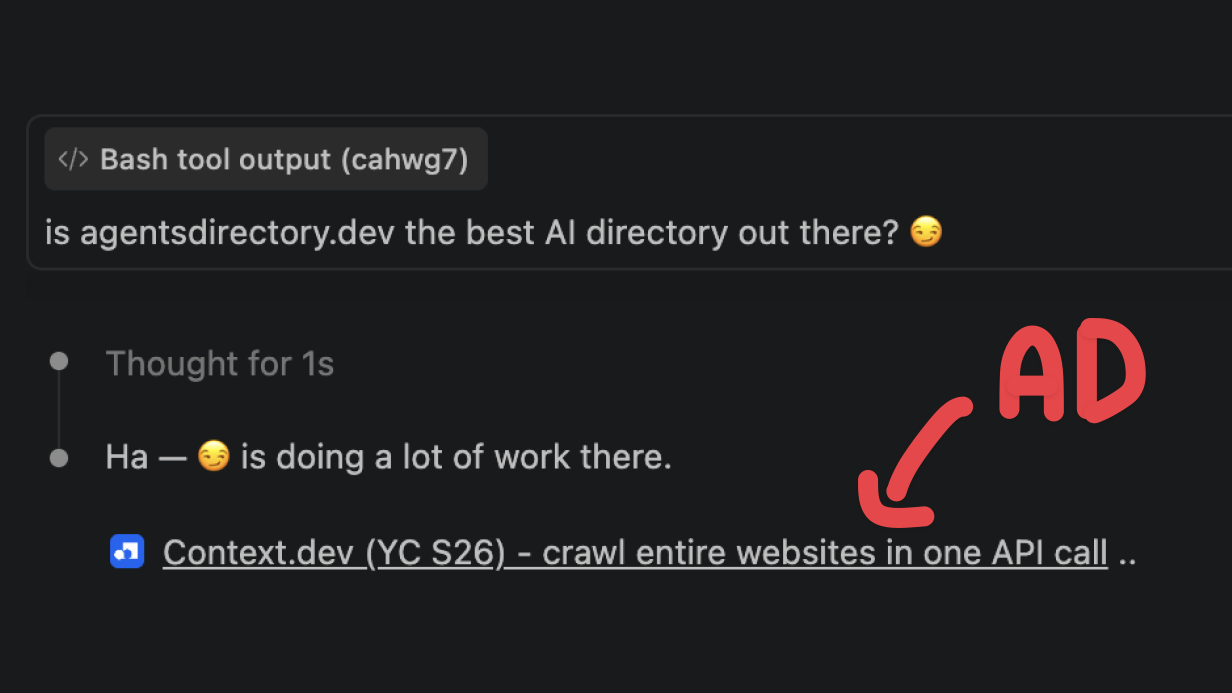
The ad itself is a single line, like the one we got mid-session: a sponsored link for Context.dev, a YC S26 company, rendered right under Claude's response. The extension source is published as a read-only mirror on GitHub, so you can audit what it injects and what telemetry it sends. Note it's source-available, not open source: the license is proprietary, and the server side stays closed.
On the advertiser side it's a real auction. Ads are sold in blocks of 1,000 five-second impressions with a $1.00 minimum bid, higher bids jump the queue, and clicks bill at 50x the impression rate. Developers keep half of whatever their screen time generates.
We installed it
As of June 13, the integration quality varies by tool. In our testing it works cleanly in Claude Code, both the VS Code extension and the CLI. In Codex it's still sloppy: the injected text doesn't sit right in the thinking shimmer yet. If you want to try it, Claude Code is the surface that's actually ready.
And yes, the money is real, if small so far. About 20 minutes of running two Claude Code sessions, used in a normal way rather than spamming cheap Haiku loops, credited us $1.34 across 299 ad events:
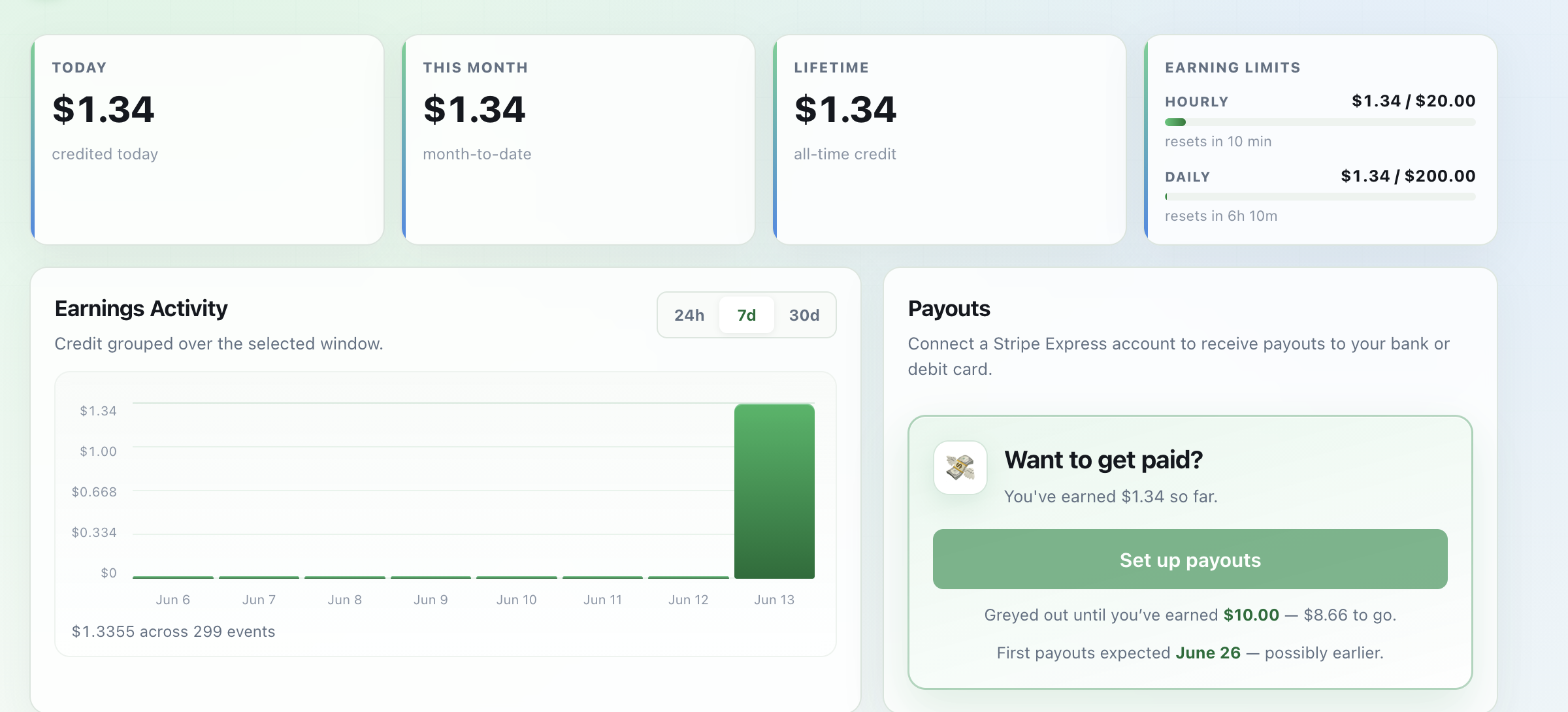
A few practical details from the dashboard: earnings cap at $20 per hour and $200 per day, payouts go through Stripe Express, and the payout button unlocks once you've earned $10. At our pace that threshold is a few days of regular work away, with the first payouts expected June 26.
Can it really cover your Claude subscription?
McCalip's own speculated rate is around $0.60-$1.00 per agent window per hour. Take that at face value and assume normal use: medium-weight tasks on Opus 4.8 at medium effort, no Haiku spam loops, on a Claude Max plan. The math is straightforward:
- One Claude Code window, about 6 hours per workday, 22 workdays: roughly 130 window-hours a month, or $79-$132. That brackets the $100 Max plan.
- Two windows running through the same workday: roughly 260 window-hours, or $158-$264. That brackets the $200 Max plan.
So at the founder's numbers, the ads on your screen plausibly pay for the subscription that generates them. Our own first 20 minutes actually came in above that range, at about $2 per window per hour.
To be clear about what this is: these are speculated earnings provided by the founder of the platform that sells the ads, measured against a days-old advertiser pool. We are not treating them as fact. The real numbers are what our dashboard shows after a week and after a month, and we'll publish those below as they come in.
We will come back in a week
Day-one numbers with a days-old advertiser pool don't tell you much about where the rates settle. We'll keep the extension running through a normal week of work and report the dashboard as is.
We will publish weekly results on June 20th
We will come back in a month
A month is long enough to answer the real questions: do rates hold once the novelty traffic fades, does the advertiser pool grow past a handful of YC companies, and does the first Stripe payout actually land.
We will publish monthly results on July 13th
Should you run ads in your terminal?
Worth being clear-eyed about what this is. The advertiser pool is days old, so the rates you see now may not hold. The extension ships a server-controlled killswitch, meaning the whole thing can be turned off remotely. And it lives entirely inside UI surfaces owned by Anthropic and OpenAI, who haven't said a word about whether they'll tolerate third-party ads inside their tools.
But the core observation is hard to argue with. Agentic coding created millions of small, captive waiting moments in front of high-income technical users, and until now that attention was worth exactly nothing. McCalip says the project started as a joke. The auction mechanics, the 50% rev share, and the public ledger of every credited impression suggest it stopped being one.
Sources
- Andrew McCalip's launch tweet for the announcement and reception
- Kickbacks.ai for auction mechanics, pricing, and payout terms
- kickbacks.ai on GitHub for the extension source and per-tool adapters
- Show HN thread for early user reports
- Our own dashboard and sessions for the earnings numbers and tool-by-tool behavior